
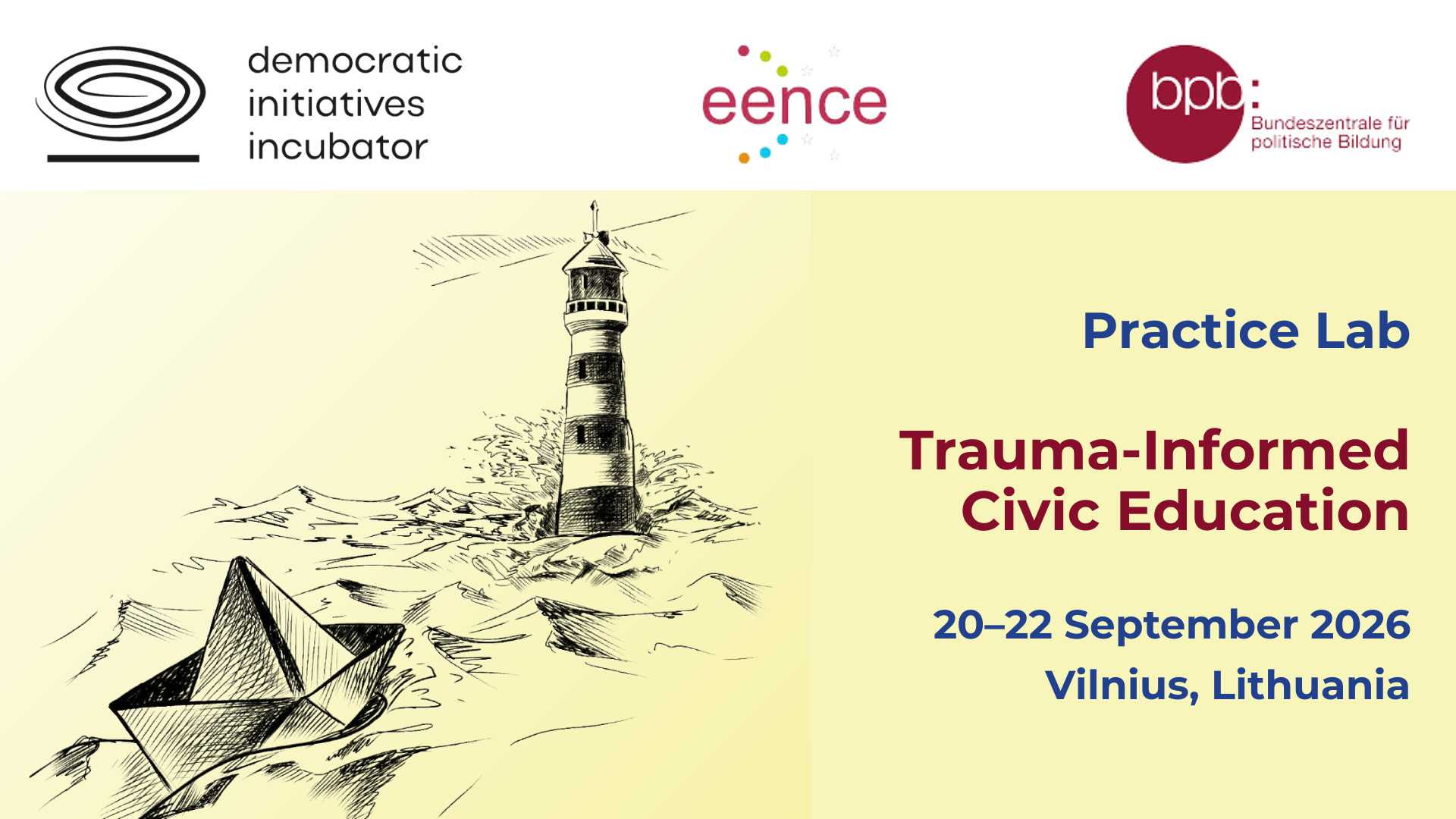
How can we design educational programmes that foster democratic values while creating safe learning environments and taking the impact of trauma into account?
The answers to these questions cannot be found in theory alone. They emerge through professional dialogue, analysis of real-life cases, and collaborative problem-solving.
That is why we invite civic education practitioners to join the Practice Lab—an international professional exchange dedicated to advancing trauma-informed approaches in civic education.
The Practice Lab is organised as part of the project “Co-creating and Implementing Trauma-Informed Tools for Civic Education in Eastern Partnership Countries.”
Who is this Practice Lab for?
We welcome professionals who already have experience applying trauma-informed approaches—or individual trauma-informed principles—in their educational practice.
The Practice Lab will be particularly relevant for:
- educators;
- trainers;
- facilitators;
- human rights education professionals;
- youth workers;
- representatives of civil society organisations;
- researchers of educational practice.
We are looking not for passive participants, but for colleagues who are willing to share their experience, discuss complex professional challenges, and collaboratively develop new ideas and solutions.
What makes this format unique?
This is not a conference. It is not a training course. And it is not a series of lectures.
The Practice Lab is a space for peer learning, where everyone is both an expert and a learner.
Each participant brings their own professional experience: successful practices, challenging situations, and questions that still have no straightforward answers. These experiences become the core content of the programme.
How will the Practice Lab work?
Each participant will prepare and facilitate a 30-minute practical session for the group.
The format is flexible and may include:
- presentation of an educational case;
- an interactive learning activity;
- a practical workshop;
- a facilitated discussion;
- analysis of a professional dilemma;
- exploration of a challenging situation from one’s own practice;
- demonstration of a method or educational tool.
We particularly encourage participants to share not only success stories but also professional challenges, mistakes, uncertainties, and questions that require collective reflection.
Together we will explore
- how traumatic experiences influence educational processes;
- how to create safe learning environments without reducing participation and open dialogue;
- how to address the diverse needs of different learner groups;
- how to support the wellbeing and resilience of educators, trainers, and facilitators;
- how to evaluate the effectiveness of trauma-informed educational programmes;
- how to integrate trauma-informed approaches into civic education while preserving its democratic and participatory nature.
A central part of the programme will be devoted to analysing real cases contributed by participants. Together we will examine concrete situations, explore alternative responses, and discuss which approaches may be most effective in different educational contexts.
What will be the outcome?
The Practice Lab is more than an opportunity for professional exchange.
As a result of the collaborative work, participants will become co-authors of an international practical guide on applying trauma-informed approaches in civic education.
During the Practice Lab we will develop the first drafts of:
- practical checklists;
- recommendations for educators, trainers, and facilitators;
- response protocols for sensitive situations;
- educational programme analysis tools;
- guidance on creating safe learning environments.
Following the event, these materials will be piloted in educational practice, further refined, and published as open-access resources.
Participation conditions
For participants selected through the open call, the organisers will provide:
- accommodation in shared twin rooms;
- meals throughout the event;
- reimbursement of travel expenses.
A limited number of self-funded places will also be available.
The working languages of the Practice Lab are English and Russian. To participate fully, it is desirable to have at least a basic understanding of both working languages. However, we strive to make the Practice Lab as inclusive and accessible as possible. We recognise that each Eastern Partnership country has its own official language and rich linguistic heritage. English and Russian have been selected as the working languages solely for practical reasons, as they currently enable the broadest possible participation and communication among professionals from across the region. If the composition of the group allows for mutual language support, we also welcome participants who prefer to contribute in only one of the working languages or in their native language. In such cases, we encourage peer interpretation, where participants help one another understand discussions and exchange professional experience.
Venue: Vilnius, Lithuania
Dates: 20–22 September 2026
- 20 September: arrival before 14:00, followed by opening working sessions;
- 21 September: full day of collaborative activities;
- 22 September: working sessions until 12:00, followed by departure.
Please submit your application by 5 August 2026. Registration form: https://forms.gle/Ewapn3WzYEtN3ucG9
The Practice Lab: Trauma-Informed Civic Education is organised by the Democratic Initiatives Incubator (Ukraine) as part of the project “Co-creating and Implementing Trauma-Informed Tools for Civic Education in Eastern Partnership Countries”, with financial support from the Bundeszentrale für politische Bildung (bpb), in cooperation with the Eastern European Network for Citizenship Education (EENCE).